
断头谷
China takes overseas archaeology from Silk Road to South America_我的网站

一 | UK Prime Minister Boris Johnson has come up with a plan to repurpose arable land which is at present used for crop-based biofuels so that more food might be grown as food prices and inflation soar.,However, officials of US President Joe Biden made it clear on 26 June that Washington wouldn't "okay" Johnson's initiative in a bid to protect American farmers and avoid breaking climate commitments. According to the British daily newspaper, The Daily Telegraph, Germany appears to back the British premier's plan whereas Canada and the US have rejected it. Johnson's plan needs the unanimous support from all G7 nations for it to fly.,"I think the rift is one that happens periodically between the UK and US - without minimizing the significance, there have been tensions on trade issues for some years now (including the tariffs imposed by the Trump administration on the UK). How serious it becomes is questionable," says Professor Robert Singh, specialist in contemporary US politics at the University of London's Birkbeck College.,UK on Collision Course With US as BoJo Set to Prioritize Food Production Over Green Energy06:06 GMT,Previously, Johnson and Biden clashed over Brexit customs issues and the Northern Ireland Protocol with the American president reportedly accusing the British premier of "inflaming" Irish tensions ahead of the 2021 G7 Summit in Cornwall.,Given the record of friction between Biden and Johnson, it appears likely that if the UK does legislate to revise the Northern Ireland Protocol (NIP), Washington will react negatively, Singh suggests. Downing Street has published a Bill proposing to change the protocol unilaterally in favor of British businesses and communities. It would also grant the British government powers to amend the agreement further if appropriate.,"It's possible that [the NIP amendment] could then inflame the trade issue further," says Singh. "[I]t will worsen the Johnson government's record, at a time when the cost of living crisis, inflation, and many other problems are piling up. It's probably, on balance, yet another own goal by Johnson - an unnecessary diplomatic row that was avoidable.",To complicate matters even more, Johnson skipped a climate summit hosted by Biden for world leaders earlier this month, despite 15 other heads of state and government attending the virtual gathering. According to Politico, the premier's absence "reverses a previous snub from Biden" who declined to attend a climate meeting Johnson hosted on the sidelines of the UN General Assembly in 2021.,Yet another diplomatic row rocked London and Washington after the UK issued licences to four British flagged vessels to fish for Patagonian toothfish - also known as Chilean seabass - near Antarctica. Earlier, a 26-member fishing regulatory body, the Commission for the Conservation of Antarctic Marine Living Resources (CCAMLR) set specific catch limits for the species. The US immediately accused Britain of breaching the commission's rules, rendering the catch illegal. The feud could lead to an import ban on Patagonian toothfish, according to the media.,Northern Ireland Protocol Used as Proxy in Tory Efforts to Unseat BoJo, Legal Expert Says14 June, 18:55 GMT,UK-US Spat Can be Fixed Quicker Than That Between UK and EU,The UK-US tensions are unlikely to lead to a serious breach in relations in the near future, insists Dr Roslyn Fuller, director of the non-profit think-tank Solonian Democracy Institute and the author of the book Beasts and Gods: How Democracy Changed Its Meaning and Lost Its Purpose.,"Johnson and Biden are both career politicians and will probably behave pragmatically," says Fuller. "Even were they to exaggerate their differences in the press to play to their respective electorate, this would be unlikely to affect their highly connected working relationship greatly.",Though the NIP issue could cause some additional tensions between the UK and the US, the nations are likely to solve relatively minor dilemmas, such as the spat over the toothfish catch, according to the author.,"As the two major English-speaking powers and neoliberal nations that have cooperated intensely on military matters in the past, it would be quite stupid on their part to indulge in any serious in-fighting," she says. "I think the US is paying increasing attention to Germany as the remaining European superpower, but that doesn't necessarily have to come at the expense of the British.",However, when it comes to the UK and the EU, the rift between them indeed appears to be deepening, according to Fuller:,"Britain also obviously lost faith in the EU and its regulatory regime, and clearly wants to go its own way to the extent that it can," the author says. "This is thus an example of increasing global fragmentation."。
China is set to launch its first joint archaeological project in South America, following an agreement between Chinese and Peruvian institutions to study the ancient Caral civilization. The move marks a new milestone in the country's growing overseas archaeological cooperation.
The Institute of Archaeology of the Chinese Academy of Social Sciences, Peru's Caral Archaeological Zone under the Ministry of Culture, and the Professional School of Archaeology at the National University of San Marcos signed a cooperation agreement on Saturday to conduct research on the ancient Caral civilization.
The Caral civilization, which is considered to be the oldest civilization discovered in the Americas, emerged along Peru's northern coast and dates to around 3000 BC to about 1800 BC.
The project marks China's first joint archaeological initiative in South America, expanding its overseas archaeological footprint to four continents: Asia, Africa, Europe and South America. It also encompasses cooperation with Belt and Road partner countries, major centers of ancient civilizations and regions crucial to the study of human origins.
For Chinese archaeologists, the project represents a new step in overseas archaeological engagement and international cooperation, fostering mutual learning and dialogue among civilizations, Chinese experts said.
Cooperation beyond borders
In recent years, Chinese institutions have participated in a series of overseas archaeological projects, from exploring ancient cities along the Silk Road to studying early civilizations in Africa and Central Asia.
They not only brought Chinese expertise and talent, but also advanced Chinese technologies, equipment and solutions, experts said.
In February, a significant archaeological breakthrough has emerged from Mit Rahina in Giza, the site of ancient Memphis in Egypt, where a joint Chinese-Egyptian mission has uncovered a limestone structure believed to be connected to the temple of King Pharaoh Apries from Egypt's 26th Dynasty (664-525 BC), according to the Xinhua News Agency.
Zhang Hai, head of the Chinese team and an archaeologist from Peking University, told the Global Times in a previous interview that the Chinese contingent applied distinctive methods for documenting and recording finds, while deploying Chinese-developed technologies such as the "4D kankan Meta" 3D scanner for precise, real-time topographic and sectional modeling, plus specialized software for capturing dislocated stone elements in 3D to aid future digital restoration and preservation.
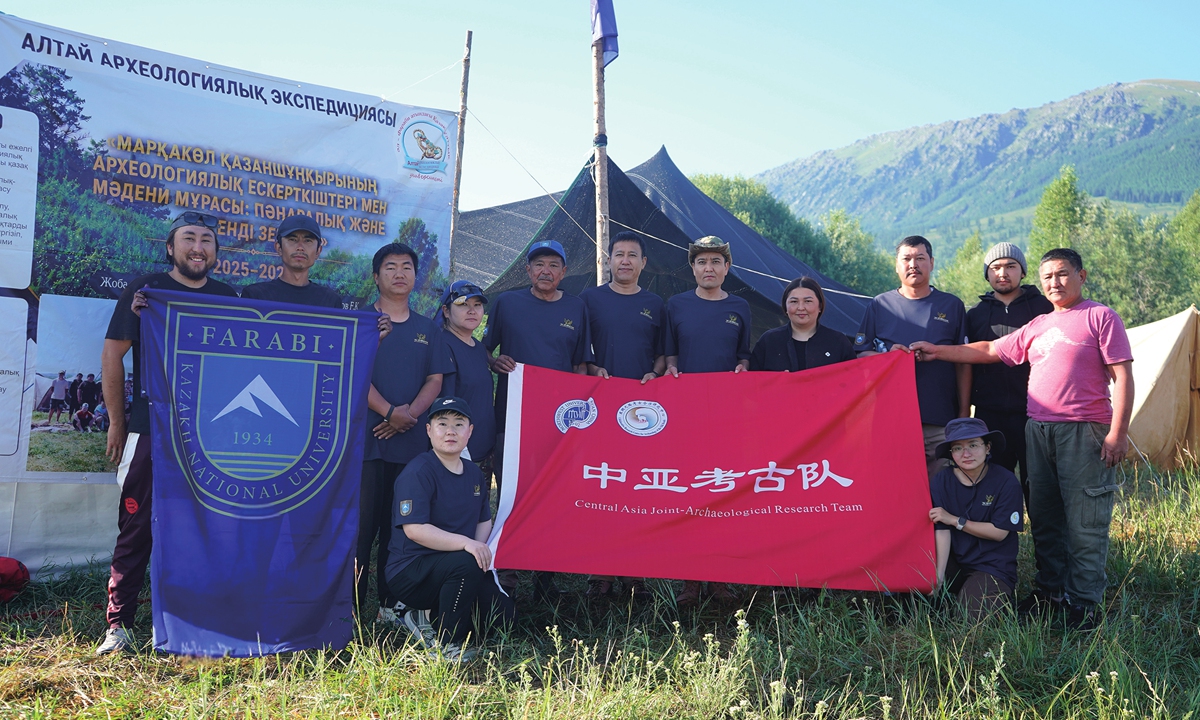
In the latest China-Kazakhstan joint archaeological project, Chinese equipment and technologies played an important role in the team's discoveries.
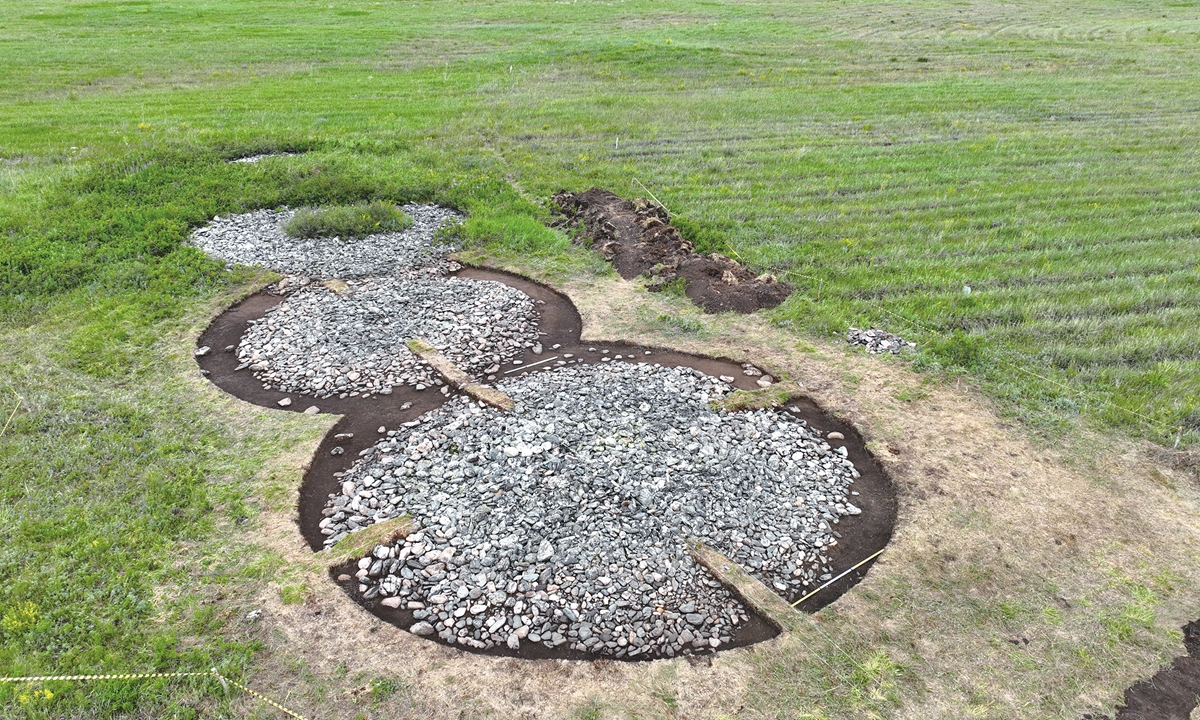
Building on the excavation, the archaeological team used drones and the "I Survey" mobile field documentation system to conduct systematic surveys around the excavation area. The survey covered more than 10 burial grounds and documented more than 50 Pazyryk-era tombs.
Pazyryk culture flourished from the late sixth century BC to the third century BC, Shao Huiqiu, a professor at the Collaborative Research Center for Archaeology of the Silk Roads, Northwest University, told the Global Times.
According to Shao, who is the Chinese lead for the China-Kazakhstan joint archaeological project, none of the tombs had previously undergone formal excavation, giving them significant research potential. The use of these technologies has enabled the team to carry out more efficient and comprehensive surveys of the area,
During the China-Kazakhstan joint archaeological project, archaeologists have recovered a number of important artifacts, including human remains, pottery, gold foil pieces, horse bones and iron horse equipment.
The finds have provide valuable material evidence for studying the burial practices, funerary customs and material culture of the Pazyryk culture in the Lake Markakol region, said Shao.
Researchers also conducted regional surveys around the excavation area, documenting more than 50 Pazyryk-era tombs.
Through the joint archaeological project, China and Kazakhstan have gained a deeper understanding of Bronze Age to Early Iron Age archaeological remains in the Lake Markakol basin, according to Shao.
In 2027, the two sides will continue excavations at key sites and burial grounds identified during the survey, while advancing regional archaeological investigations, data analysis, multidisciplinary research, young archaeologist training and academic exchanges.
Archaeological exchanges
China's overseas archaeological cooperation has also become a platform for broader exchanges among researchers and civilizations.
Such projects, experts say, are helping expand archaeological research beyond national borders and provide new perspectives on exchanges among ancient civilizations.
China's overseas archaeology has grown alongside its broader participation in global cultural heritage protection.
The National Cultural Heritage Administration's cultural heritage development plan through 2030 calls for expanded archaeological cooperation in Austronesian-speaking regions, trans-Himalayan areas, and routes connected to the Silk Road and Maritime Silk Road, reported Xinhua.
The plan seeks to strengthen the methods used to trace Chinese cultural artifacts overseas, and advance efforts to retrieve lost cultural relics.
It also pushes for greater Chinese participation in global cultural heritage governance and expanded international partnerships, including new protection cooperation agreements with more countries worldwide, according to Xinhua.
In these joint collaborations, researchers from different countries bring together their expertise in regional archaeology and fieldwork, conducting exchanges on archaeological surveys, excavations, multidisciplinary research and regional cultural studies. Such cooperation has strengthened mutual learning and laid a foundation for long-term partnerships, according to Shao.
The China-Uzbekistan cooperation has established research centers in Samarkand and Termez to support studies on human-environment interactions and cultural heritage. The initiative has also trained professionals in Silk Road archaeology, scientific research and heritage conservation through programs for Uzbek universities and research institutions, while promoting international academic exchanges to advance Silk Road heritage protection and cultural cooperation, noted Zhu Jiangsong, a member of the China-Uzbekistan joint archaeological team from the School of Cultural Heritage, Northwest University.
Through these partnerships, Chinese archaeologists are not only contributing technology, research experience and training, but also gaining first-hand materials and fresh perspectives that help advance the study of ancient civilizations and enrich China's archaeological research.
。

二 |
Current article:http://ncrsw7q.zhenzongtingrangunhongqiusao.shop/7npj0/vh86.html
Published on:13:33:20
 罗马假日
罗马假日 银魂 真人版