
游戏人生
SL wants Bisons from India or not?_我的网站

一 | Colombo, Oct 20 (UNI) A Sri Lankan biodiversity scientist wants to import six Bisons from India but the plan has run into weather from the department of forest.
The scientist who is also a public policy advisor do not have permission from the Department of Forest Conservation and the Department of Wildlife Conservation to buy the Bisons from India, The Island newspaper on Thursday quoted the Centre for Environmental Justice (CEJ) as saying.
CEJ Director and Chief Advisor Hemantha Withanage said: “The Department of Wildlife Conservation states that these animals are found in the central region of India and there are problems regarding their adaptation to Sri Lanka."
Biodiversity expert Rohan Pethiyagoda said he was under the impression that the CEJ had been misled by an Indian newspaper report that there was a proposal to reintroduce in the Sri Lankan wild gaur or Indian Bisons which became extinct in the island nation some centuries ago.
“The demography of Sri Lanka has changed drastically for that to be feasible, and we have enough and more problems with human-elephant conflict. All I requested our High Commissioner in Delhi was to ascertain if the Indian government might in principle be willing to entertain a request from Sri Lanka to establish a herd of gaur in our National Zoological Gardens,” he told the Mirror.
“That is all there is to this. Of course, there may be those who are opposed to the idea of the zoo maintaining a herd of gaur. But in my opinion, most Sri Lankans would like such a move."
He said the reintroduction of the species to the wild was a hugely expensive, scientifically complex and time-consuming enterprise.
“But I would be astonished if anyone thought there is anything wrong with the last large mammal species to become extinct in Sri Lanka being represented in our national zoo.”
UNI MR。
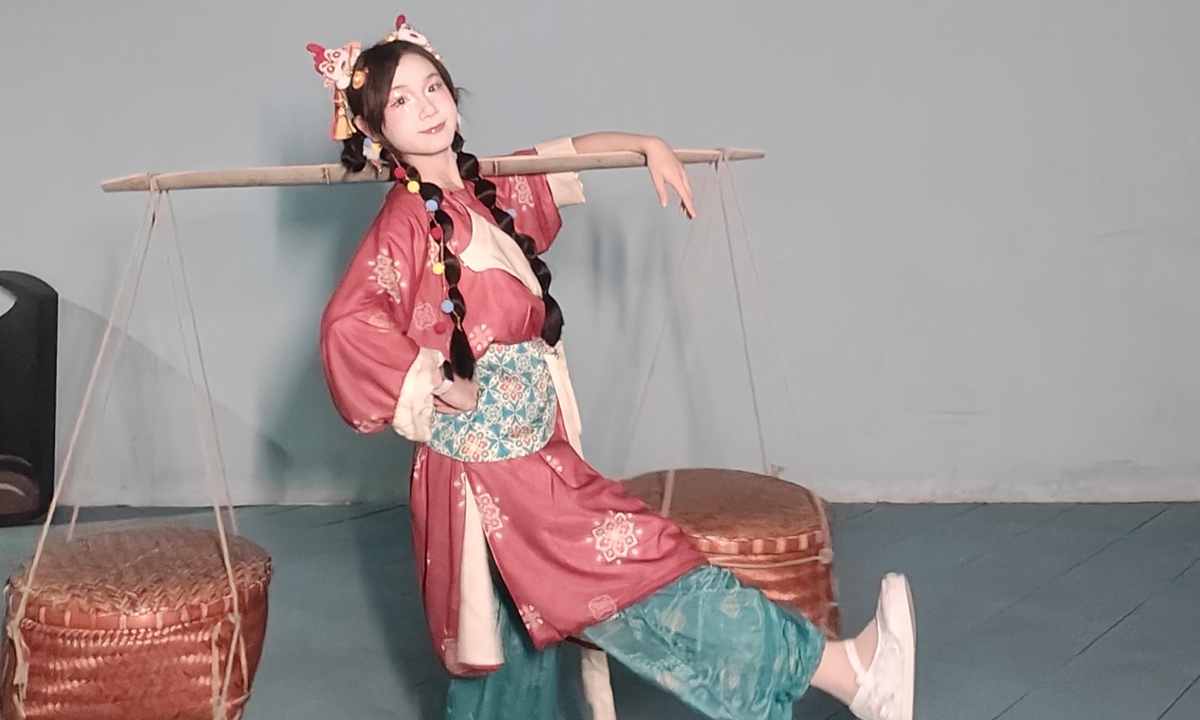
Bing Bing, a young acrobat born in the 2000s, told the Global Times that she first tested the "tossing and eating an apple" routine through short videos before taking it to the stage. After her first performance, she spent the holidays performing it, adjusting the movements and pacing based on how audiences responded.
"Performance is the hardest thing to master. Your facial expressions and body movements have to convey to the audience what you are doing and what you want to do," she said. "The goal is to make them know that you are performing, yet still find it entertaining."
According to Bing Bing, the training behind such performances is far less glamorous than the finished act suggests. "Training is very repetitive. You fail, repeat, fail again, succeed and then fail again," she said. "Practice is what turns quantity into quality, even facial expressions and body movements require deliberate practice."
For Bing Bing, however, mastering the routine is only one part of the job. Once performers step in front of an audience, the carefully rehearsed movements have to adapt to a live and unpredictable setting.
Beyond the theater
In recent years, acrobatic performances have increasingly moved into aquariums, theme parks and cultural tourism venues, where audiences themselves become part of the performance rather than simply watching from fixed seats.
Bing Bing previously performed alongside other clowns at an aquarium, inviting visitors to participate in the act. She said the difference is not merely a change of venue: performers have to constantly interact with the people in front of them.
"Traditional stages are farther away from the audience and are better suited to performances that people simply watch," she said. "Aquariums and theme parks, however, place greater emphasis on interaction and connection with the audience. Even with the same routine and interactions, you can often get unexpected results."
That interaction also changes how performers think about rhythm and presentation. A routine that works in a theater cannot necessarily be transferred unchanged to a tourist attraction, where audience reactions, distance and participation can all alter what happens on stage.
Sun Dawei, head of the Wuqiao Acrobatic School, told the Global Times that this shift is also changing the industry's approach to production.
"Acrobatics used to focus mainly on showcasing skills. Now there is greater emphasis on story-telling and emotional expression," he said. "Performances are no longer confined to theaters, but are increasingly staged as resident shows at cultural tourism venues."
According to Sun, a production usually begins with a theme, followed by the selection of appropriate skills. Performers then refine the routine repeatedly before adding music and stage design and going through multiple rehearsals.
"Traditional signature skills and core fundamentals must be preserved," he said. "Content that simply pursues danger or no longer fits contemporary aesthetics needs to be repackaged. Traditional skills should be given new forms of expression while retaining their roots and appealing to modern audiences."
For Bing Bing, this shift has also been made possible thanks to short-video platforms. Her apple routine gained its first wide exposure online before audiences encountered it in person.
"Short videos have helped more people learn about Chinese acrobatics and traditional culture, and encouraged more people to go to theaters and watch performances offline," she said.
The growing visibility of acrobatics online, however, has raised another question: once traditional skills enter new venues and digital platforms, how can performers avoid simply repeating familiar formulas?
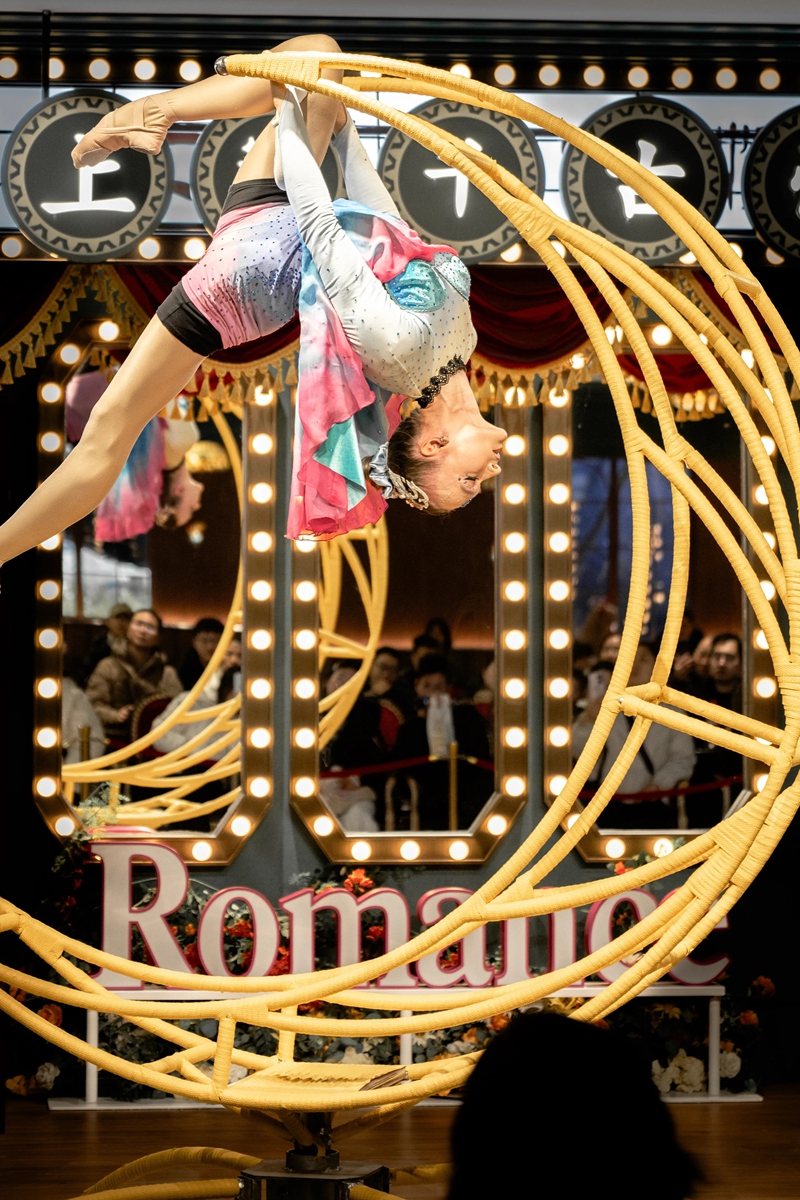
Russian aerial acrobat Liza, who has lived and worked in China for more than seven years and now performs regularly at Shanghai Qianguqing, a large-scale cultural tourism attraction featuring live performances, noted that the answer lies in how a show is constructed as a whole.
"A performance should start with an overall concept, and then you choose the props and music around it. Music itself can guide the choice of movements, provided the performer already has a solid technical foundation," Liza told the Global Times. "The transitions between movements have to be natural and smooth, like telling a story step by step. Costumes are also important because they complete the character. Everything needs to work together."
For Liza, technical difficulty should serve the performance rather than become the performance itself.
"Real professionalism means making the audience unable to see how hard you are working. Everything should look effortless," she said. "I value beauty and precision in movement. You should not make things more complicated simply to show off your skills. You should improve steadily as you grow as a performer, rather than constantly chasing greater difficulty."
She said that this is particularly important as increasingly extreme acts, including hair- and tooth-hanging, attract attention online.
"Most performers are following established templates, and I rarely see people creating something that is truly their own," Liza said. "You can find your own style and way of expression without taking excessive risks."
From an apple-tossing routine that drew more than 6 million likes to performances in aquariums and cultural tourism venues, traditional acrobatics is finding new ways to reach audiences. But bringing an old art back into the spotlight is not simply about making tricks harder or more spectacular. As Bing Bing's apple routine shows, sometimes it takes a familiar skill presented in an unfamiliar way to make a new generation stop and watch again.
。

二 |
Current article:http://ncrsw7q.zhenzongtingrangunhongqiusao.shop/news/20260826_369.html
Published on:14:04:52